
Blog Page
Discover expert insights, practical tips, and the latest trends in digital marketing. Our blog covers SEO, social media, Google Ads, website design, content creation, email marketing, and more. Stay informed, grow your business, and achieve better online results with every article.
What is SEO and Why is it Important?
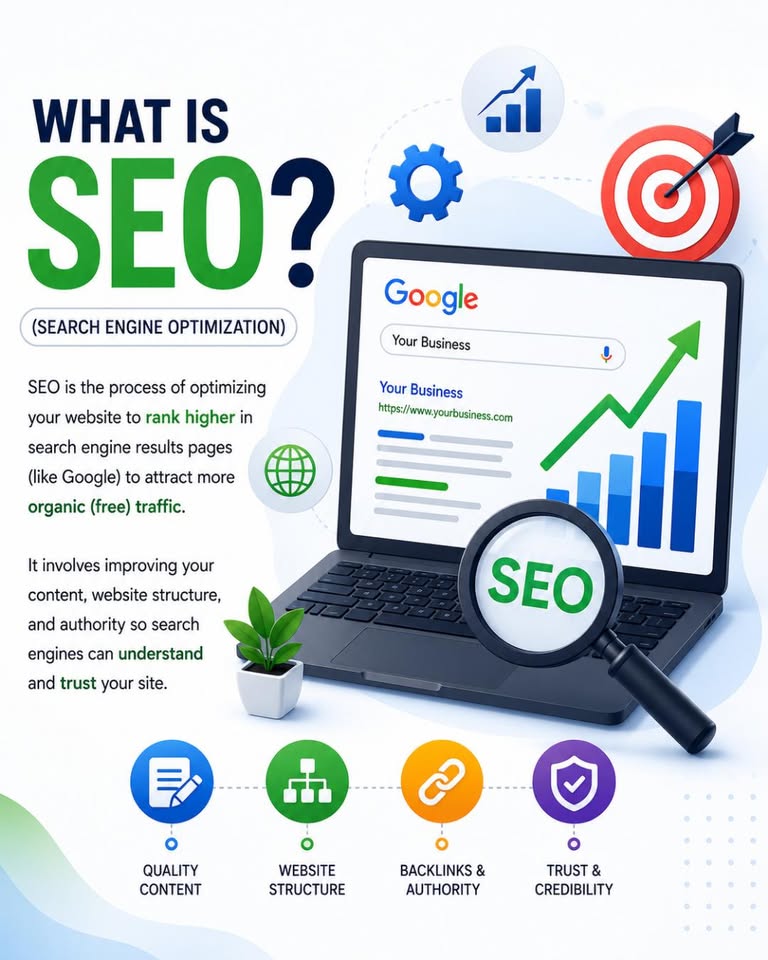
Search Engine Optimization (SEO) is the process of improving a website to increase its visibility in search engine results pages (SERPs) such as Google, Bing, and Yahoo. The main goal of SEO is to attract organic (non-paid) traffic by making a website more relevant, useful, and trustworthy for users searching for specific information, products, or services.
Whenever someone types a query into a search engine, it scans billions of web pages and ranks them based on hundreds of factors, including content quality, relevance, website speed, user experience, and authority. SEO helps optimize these factors so that a website has a better chance of appearing on the first page of search results. Since most users rarely go beyond the first page, achieving higher rankings can significantly increase website traffic and business opportunities.
SEO is not just about using keywords. It involves creating valuable content, improving website structure, enhancing user experience, and ensuring that search engines can easily crawl and understand your website. A successful SEO strategy combines technical improvements, quality content, and strong online credibility.
Why is SEO Important?
1. Increases Organic Website Traffic
2. Builds Brand Visibility and Awareness
One of the biggest advantages of SEO is that it drives free, organic traffic. Unlike paid advertising, you don’t have to pay for every visitor who clicks on your website. As your rankings improve, more people discover your website naturally through search engines.
When your website consistently appears at the top of search results, more users become familiar with your brand. Even if they don’t click immediately, repeated visibility helps build brand recognition and trust over time.
3. Generates High-Quality Leads
4. Improves User Experience
SEO targets users who are actively searching for products or services related to your business. These visitors already have an interest or need, making them more likely to become customers compared to people reached through general advertising.
Modern SEO focuses heavily on user experience. Search engines reward websites that load quickly, are mobile-friendly, easy to navigate, and provide useful content. A better user experience also leads to higher engagement and increased conversions.
5. Builds Trust and Credibility
6. Offers Long-Term Results
Websites that rank highly are often viewed as more reliable and authoritative. Publishing accurate information, earning backlinks from trusted websites, and maintaining a secure website (HTTPS) all contribute to building credibility with both users and search engines.
Unlike paid advertising, where traffic stops as soon as the budget runs out, SEO can continue generating visitors for months or even years after optimization. Although SEO takes time, it provides long-lasting benefits and a strong return on investment.
7. Supports Local Business Growth
8. Gives You a Competitive Advantage
Local SEO helps businesses appear in searches such as “digital marketing agency near me” or “best restaurant in Ahmedabad.” Optimizing your Google Business Profile, local keywords, and customer reviews helps attract nearby customers who are ready to buy.
If your competitors are investing in SEO and you are not, they are likely capturing customers who could have found your business instead. A strong SEO strategy helps your website compete effectively and gain more market share.
Types of SEO :
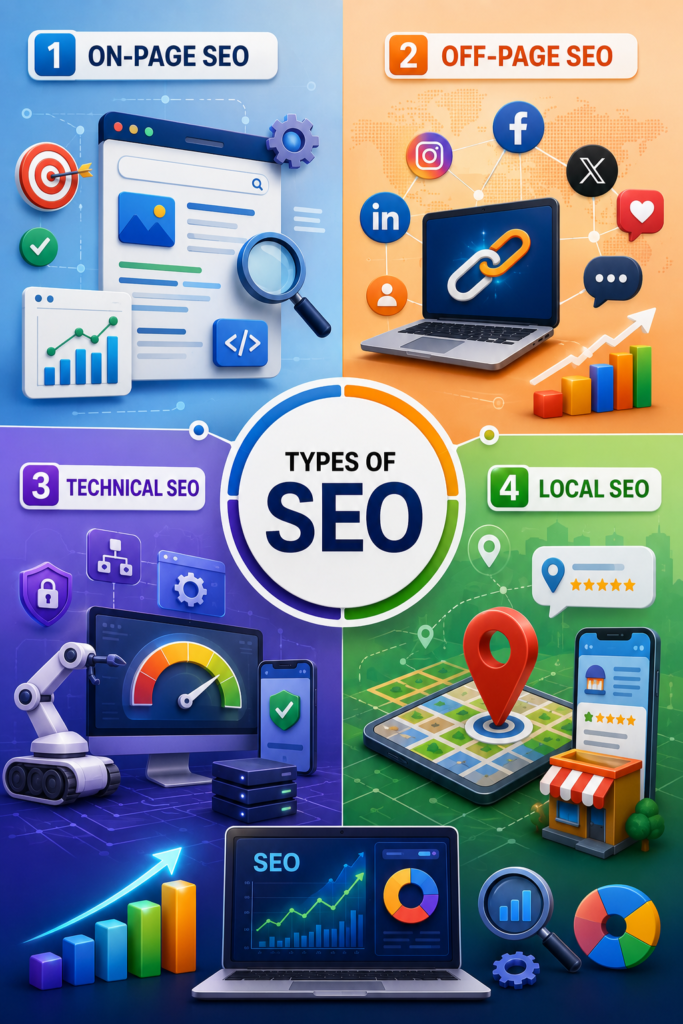
1. On-Page SEO
On-page SEO involves optimizing elements within your website, including:
- Keyword research and placement
- High-quality, informative content
- SEO-friendly page titles and meta descriptions
- Proper heading structure (H1, H2, H3)
- Internal linking
- Image optimization with alt text
- URL optimization
2. Off-Page SEO
Off-page SEO focuses on improving your website's authority through external factors, such as:
- High-quality backlinks
- Brand mentions
- Guest blogging
- Social media engagement
- Online reviews
- Influencer collaborations
3. Technical SEO
Technical SEO ensures search engines can crawl, index, and understand your website efficiently. It includes:
- Website speed optimization
- Mobile responsiveness
- HTTPS security
- XML sitemap
- Robots.txt optimization
- Structured data (Schema Markup)
- Fixing broken links and crawl errors
4. Local SEO
Local SEO helps businesses reach customers within a specific geographic area. It includes
- Google Business Profile optimization
- Local keyword targeting
- NAP (Name, Address, Phone Number) consistency
- Local citations
- Customer reviews
- Location-specific content
How Search Engines Work
Search engines follow three main steps:
1.Crawling:
Search engine bots discover web pages by following links.
2.Indexing:
The discovered pages are stored and organized in a massive database.
3.Ranking:
When someone searches, the search engine evaluates indexed pages and ranks the most relevant and high-quality results first.
Key SEO Ranking Factors
Some important ranking factors include:
- High-quality, original content
- Relevant keywords
- Fast page loading speed
- Mobile-friendly design
- Secure HTTPS website
- Quality backlinks
- Good user experience
- Internal linking
- Optimized images
- Fresh and regularly updated content
Benefits of SEO for Businesses
Businesses that invest in SEO often experience:
- Higher search engine rankings
- Increased website traffic
- Better brand awareness
- More qualified leads
- Higher conversion rates
- Lower customer acquisition costs
- Improved customer trust
- Long-term business growth
Example
Imagine you own a digital marketing agency offering SEO services.
Without SEO, your website may appear on the fifth or tenth page of Google, where very few users visit. Potential customers searching for “SEO services in Ahmedabad” may never find your business.
With effective SEO, your website can rank on the first page for relevant keywords. This increases visibility, attracts more visitors, generates quality leads, and ultimately helps grow your business without relying solely on paid advertising.
Conclusion
SEO is one of the most effective digital marketing strategies for increasing online visibility, attracting qualified visitors, and growing a business. By combining high-quality content, technical optimization, user-friendly website design, and strong online authority, SEO helps websites achieve better rankings in search engines and deliver long-term results. Whether you run a small local business, an e-commerce store, or a large enterprise, investing in SEO is essential for building a sustainable online presence and staying competitive in today’s digital world.
Social Media Marketing Trends:
A Complete Guide
Introduction
Social media marketing has become one of the most influential aspects of digital marketing in the modern business world. Over the past decade, social media platforms have evolved from simple networking websites into powerful marketing ecosystems where businesses can connect with customers, build brand awareness, generate leads, increase sales, and establish long-term relationships. Today, billions of people actively use platforms such as Facebook, Instagram, LinkedIn, YouTube, Pinterest, X (formerly Twitter), Snapchat, and TikTok, making social media one of the most valuable channels for businesses of every size.
However, social media is constantly changing. Algorithms are updated frequently, user preferences evolve, and new technologies reshape how content is created and consumed. Businesses that continue using outdated marketing strategies often experience declining engagement and reduced visibility. To remain competitive, marketers must stay informed about emerging trends and adapt their strategies accordingly.
Modern social media marketing is no longer just about publishing attractive posts. It involves creating meaningful conversations, providing value to audiences, using artificial intelligence, analyzing customer behavior, leveraging video content, collaborating with creators, and building communities that foster long-term brand loyalty. The following sections explore the most important social media marketing trends shaping the digital landscape today.
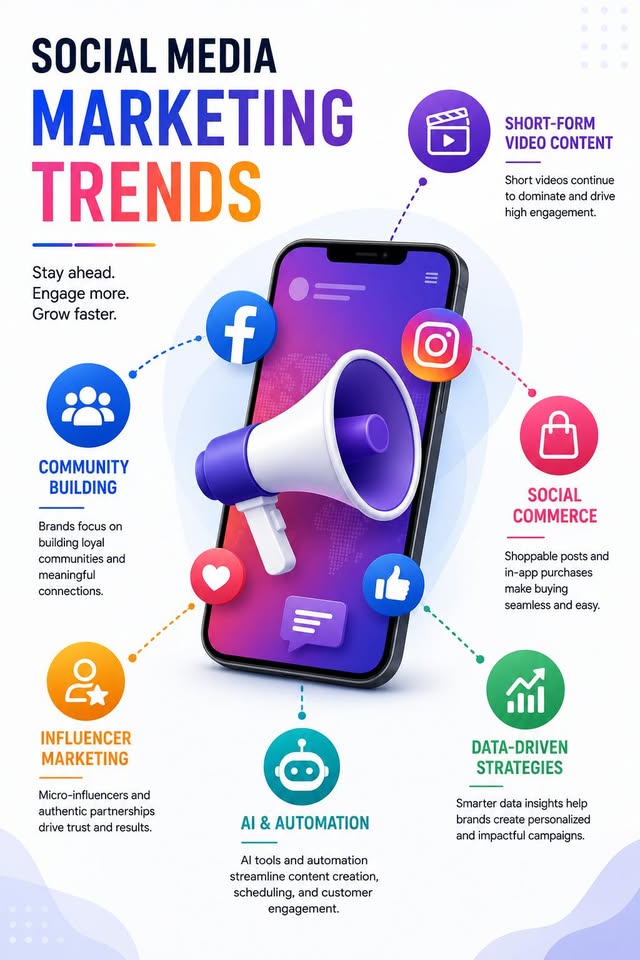
1. The Rise of Short-Form Video Content
One of the most significant trends in social media marketing is the explosive growth of short-form video content. Platforms such as Instagram Reels, YouTube Shorts, Facebook Reels, and TikTok have transformed the way people consume information online. Users now prefer watching quick, engaging videos rather than reading lengthy text posts.
Short-form videos allow brands to capture audience attention within the first few seconds and deliver valuable information in a highly engaging format. These videos are ideal for product demonstrations, tutorials, customer testimonials, behind-the-scenes content, educational tips, entertainment, and storytelling. Since platform algorithms prioritize video content, businesses using short-form videos often experience higher organic reach and engagement compared to static images.
Successful short-form videos typically include a compelling opening hook, clear messaging, subtitles for silent viewing, engaging visuals, trending music, and a strong call-to-action encouraging viewers to like, comment, share, or visit the company’s website.
2. Artificial Intelligence (AI) in Social Media Marketing
Artificial Intelligence has become one of the most transformative technologies in digital marketing. AI-powered tools help marketers automate repetitive tasks, improve efficiency, analyze customer behavior, generate content, and personalize marketing campaigns.
Businesses now use AI to write captions, create blog articles, design graphics, generate marketing images, edit videos, suggest hashtags, schedule content, monitor social conversations, and even predict customer behavior based on historical data.
AI-powered chatbots also improve customer service by answering common questions instantly, assisting customers 24/7, and reducing response times. Marketing teams use AI analytics to identify the best posting times, discover trending topics, and optimize advertising campaigns for better performance.
Despite these advantages, human creativity remains essential. The most successful brands combine AI efficiency with authentic storytelling and emotional communication.
3. Authentic Content is More Valuable Than Perfect Content
Consumers today value authenticity more than polished advertisements. Audiences have become increasingly skeptical of heavily edited promotional content and instead prefer brands that appear genuine, transparent, and relatable.
Authentic content includes behind-the-scenes videos, employee stories, company culture, product development processes, customer testimonials, founder journeys, live sessions, and real-life experiences.
Brands that openly communicate both successes and challenges often build stronger trust with their audiences. Authentic storytelling creates emotional connections, making customers more likely to engage with the brand and recommend it to others.
Instead of striving for perfection, businesses should focus on honesty, consistency, and meaningful communication.
4. Creator Economy and Influencer Marketing
Influencer marketing continues to evolve as businesses recognize the value of trusted creators. Rather than relying exclusively on celebrities, many brands now collaborate with micro-influencers and nano-influencers who have smaller but highly engaged communities.
Micro-influencers often maintain closer relationships with their followers, resulting in higher engagement rates and greater credibility. Their recommendations feel more authentic than traditional advertisements.
Brands increasingly establish long-term partnerships with creators instead of one-time sponsored posts. These ongoing collaborations produce more consistent messaging and strengthen audience trust over time.
Influencer marketing has expanded beyond lifestyle content and now includes technology, education, healthcare, finance, fitness, travel, beauty, food, and business industries.
5. User-Generated Content (UGC)
User-generated content refers to photos, videos, reviews, testimonials, and experiences voluntarily shared by customers. Instead of relying entirely on professionally created advertisements, brands encourage customers to showcase their real experiences.
UGC provides powerful social proof because potential customers generally trust other consumers more than promotional content from companies.
Businesses actively encourage customers to post product reviews, unboxing videos, before-and-after transformations, tutorials, and success stories using branded hashtags. Companies frequently repost this content across their official social media pages.
This strategy not only increases trust but also significantly reduces content production costs while strengthening community engagement.
6. Community Building Becomes a Priority
Follower counts alone no longer determine marketing success. Modern brands prioritize building active communities where audiences feel connected and valued.
Community building involves responding to comments, answering direct messages, hosting live discussions, encouraging user participation, creating private groups, organizing online events, and recognizing loyal customers.
Strong communities increase customer retention because people develop emotional relationships with brands they actively interact with. Members often become brand advocates who voluntarily recommend products and services to friends and family.
Businesses investing in community management frequently experience higher customer loyalty and improved long-term growth.
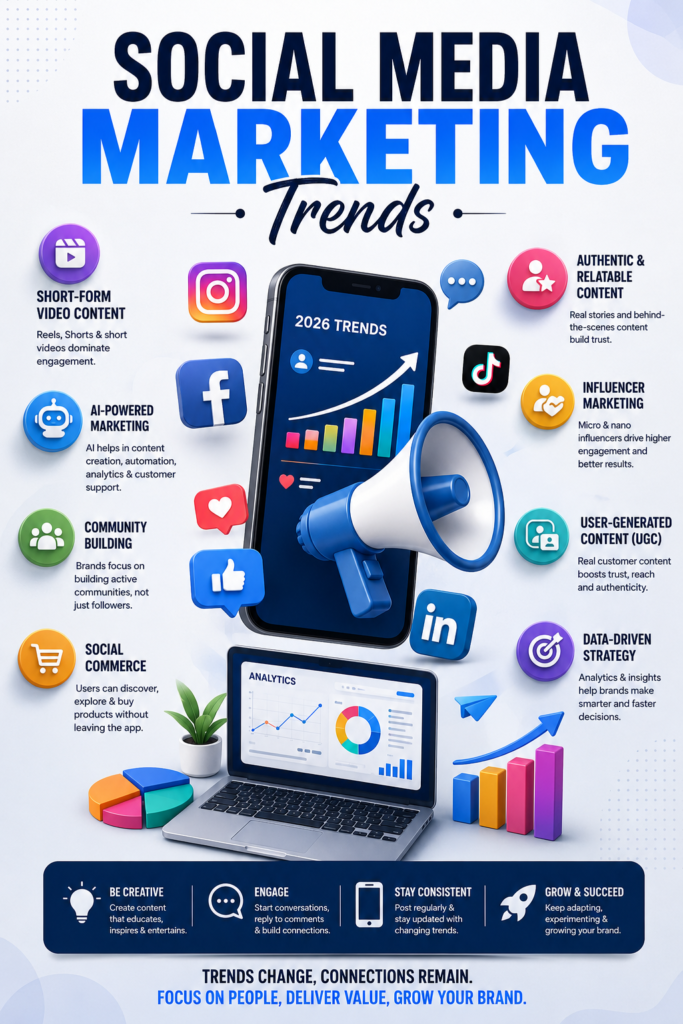
7. Social Commerce Continues to Expand
Social commerce combines social media engagement with online shopping experiences. Instead of directing users to external websites, platforms now allow customers to browse products, read reviews, watch demonstrations, and complete purchases directly within the application.
Instagram Shops, Facebook Shops, TikTok Shop, Pinterest Shopping, and YouTube Shopping have simplified the purchasing journey.
Features such as product tags, live shopping events, influencer product recommendations, and integrated checkout systems reduce purchase friction and improve conversion rates.
As consumers become increasingly comfortable shopping directly through social platforms, businesses are investing more heavily in social commerce strategies.
8. Personalized Marketing Experiences
Modern consumers expect personalized interactions. Generic advertisements are becoming less effective as customers increasingly prefer content tailored to their interests, behaviors, and preferences.
Personalized marketing uses customer data to deliver relevant recommendations, targeted advertisements, customized email campaigns, dynamic website content, location-based promotions, and individualized shopping experiences.
Advanced marketing platforms analyze customer behavior to understand browsing history, purchasing patterns, engagement activity, and demographic information.
Businesses delivering highly personalized experiences often achieve greater customer satisfaction, stronger relationships, and improved conversion rates.
9. Social Media Search Engine Optimization (Social SEO)
Social media platforms have evolved into search engines. Many users now search Instagram, TikTok, LinkedIn, Pinterest, and YouTube instead of Google when looking for product recommendations, tutorials, restaurant reviews, travel destinations, and business advice.
To improve discoverability, marketers optimize social media content using relevant keywords, descriptive captions, searchable profile names, hashtags, image alt text, and keyword-rich video titles.
Brands that understand social SEO gain greater visibility and attract audiences actively searching for information within social platforms.
10. Live Streaming and Real-Time Engagement
Live streaming continues to gain popularity because it enables immediate interaction between businesses and customers.
Companies use live broadcasts for product launches, demonstrations, webinars, interviews, educational sessions, customer support, and question-and-answer events.
Live content creates urgency because viewers know the event is happening in real time. This increases participation, engagement, and emotional connection.
Interactive features such as live comments, polls, reactions, and audience questions make live streaming one of the most engaging forms of social media marketing.
11. Data-Driven Marketing Decisions
Marketing decisions increasingly rely on analytics rather than assumptions. Businesses monitor performance indicators to evaluate campaign effectiveness and identify opportunities for improvement.
Important metrics include:
- Reach
- Impressions
- Engagement rate
- Click-through rate
- Conversion rate
- Cost per click
- Return on ad spend
- Customer acquisition cost
- Audience demographics
- Video watch time
- Retention rate
By analyzing these metrics, marketers can continuously optimize campaigns, improve content strategies, and maximize return on investment.
12. Employee Advocacy
Employees have become valuable brand ambassadors. Organizations encourage staff members to share company culture, achievements, events, and professional expertise through their personal social media profiles.
Employee advocacy increases credibility because audiences often trust individuals more than corporate accounts.
Benefits include improved employer branding, expanded organic reach, increased trust, and enhanced recruitment efforts.
Companies frequently provide employees with content guidelines while encouraging authentic personal perspectives.
13. Privacy, Transparency, and First-Party Data
Growing concerns regarding digital privacy have significantly influenced marketing practices. Governments worldwide have introduced stricter privacy regulations, while browsers are reducing support for third-party cookies.
As a result, businesses increasingly collect first-party data directly from customers through newsletter subscriptions, loyalty programs, surveys, event registrations, mobile applications, and customer accounts.
Transparent communication about data usage helps build trust while ensuring compliance with privacy regulations.
14. Omnichannel Marketing Strategies
Today’s customer journey spans multiple platforms before making a purchasing decision. A potential customer may first discover a business on Instagram, watch product reviews on YouTube, read testimonials on Facebook, visit the company website, subscribe to an email newsletter, and finally complete a purchase.
Omnichannel marketing ensures consistent branding, messaging, and customer experiences across every digital touchpoint.
Successful businesses integrate:
- Social media
- Email marketing
- Websites
- Mobile applications
- Search engines
- Online advertising
- Customer support
- Messaging platforms
Consistency across channels strengthens brand recognition and improves customer satisfaction.
15. Sustainability and Purpose-Driven Branding
Consumers increasingly support businesses that contribute positively to society and the environment. Brands demonstrating authentic commitments to sustainability, ethical sourcing, diversity, community support, and social responsibility often develop stronger customer loyalty.
Purpose-driven marketing extends beyond advertising by aligning company values with meaningful actions.
Businesses communicate initiatives such as environmental conservation, charitable partnerships, renewable energy usage, inclusive hiring practices, and community development projects through social media storytelling.
Authenticity remains critical because audiences quickly recognize insincere marketing efforts.
Future of Social Media Marketing
The future of social media marketing will be shaped by artificial intelligence, augmented reality (AR), virtual reality (VR), automation, voice search, advanced personalization, and immersive digital experiences. Businesses will increasingly rely on predictive analytics to anticipate customer behavior and deliver highly customized content.
Creators, communities, and customer relationships will become even more important than traditional advertising. Brands that consistently provide value, educate audiences, embrace innovation, and build genuine trust will continue to grow despite changing algorithms and increasing competition.
Marketing success will depend not only on producing attractive content but also on understanding audience psychology, leveraging technology responsibly, measuring performance accurately, and adapting quickly to emerging trends.
Conclusion
Social media marketing has evolved into a sophisticated discipline that combines creativity, technology, psychology, and data analysis. Today’s leading trends—including short-form video, AI-powered marketing, authentic storytelling, influencer partnerships, social commerce, community building, user-generated content, personalization, social SEO, live streaming, privacy-focused strategies, and omnichannel marketing—are transforming how businesses connect with consumers.
Organizations that embrace these trends can build stronger brand awareness, increase customer engagement, generate higher-quality leads, improve conversion rates, and establish lasting customer loyalty. As digital platforms continue to evolve, continuous learning, experimentation, and adaptability will remain essential for long-term success. Businesses that prioritize genuine relationships, valuable content, and innovative strategies will be best positioned to thrive in the ever-changing world of social media marketing.
Top Google Ads Tips for Beginners:
A Complete Guide to Running Successful Campaigns
Google Ads is one of the most powerful online advertising platforms available today. It enables businesses of all sizes to reach potential customers at the exact moment they are searching for products or services online. Whether you own a local business, an e-commerce store, or a digital marketing agency, Google Ads can help you increase website traffic, generate quality leads, boost sales, and grow brand awareness.
However, many beginners make common mistakes such as targeting the wrong audience, choosing poor keywords, or spending too much money without seeing results. Success with Google Ads is not about having the biggest budget—it is about creating well-planned campaigns, understanding your audience, and continuously optimizing your ads.
This comprehensive guide explains the most important Google Ads tips every beginner should know before investing in advertising.
1. Understand How Google Ads Works
Before creating your first campaign, it’s important to understand how Google Ads functions.
Google Ads operates on a pay-per-click (PPC) model, which means advertisers only pay when someone clicks on their advertisement. Every time a user searches on Google, an auction takes place. Google evaluates advertisers based on several factors, including their bid amount, ad quality, landing page experience, and expected click-through rate. The advertisers with the highest Ad Rank are more likely to have their ads displayed.
Google Ads allows businesses to advertise across multiple platforms, including Google Search, YouTube, Gmail, Google Maps, and millions of websites that are part of the Google Display Network.
Understanding this system helps beginners realize that simply bidding the highest amount is not enough. Google rewards advertisers who provide relevant, useful, and high-quality advertisements.
2. Set Clear Marketing Goals
Many beginners launch campaigns without defining what they actually want to achieve. Every successful Google Ads campaign starts with a clear objective.
Some common advertising goals include:
- Increasing website traffic
- Generating phone calls
- Getting more WhatsApp inquiries
- Driving online sales
- Booking appointments
- Collecting leads
- Increasing brand awareness
- Promoting local business visits
For example, a beauty salon may focus on increasing bookings for facials and hair treatments, while a digital marketing agency may aim to generate consultation requests from business owners.
Having a defined objective helps you choose the right campaign type, bidding strategy, audience, and keywords.
3. Know Your Target Audience
One of the biggest mistakes beginners make is trying to advertise to everyone.
Instead, identify your ideal customer by considering:
- Age group
- Gender
- Location
- Income level
- Interests
- Occupation
- Online behavior
- Problems they want to solve
For example:
A local restaurant should target customers living nearby.
An online clothing store may target shoppers across the country.
A digital marketing agency may focus on business owners, startups, and entrepreneurs.
The more specific your audience, the better your campaign performance will be.
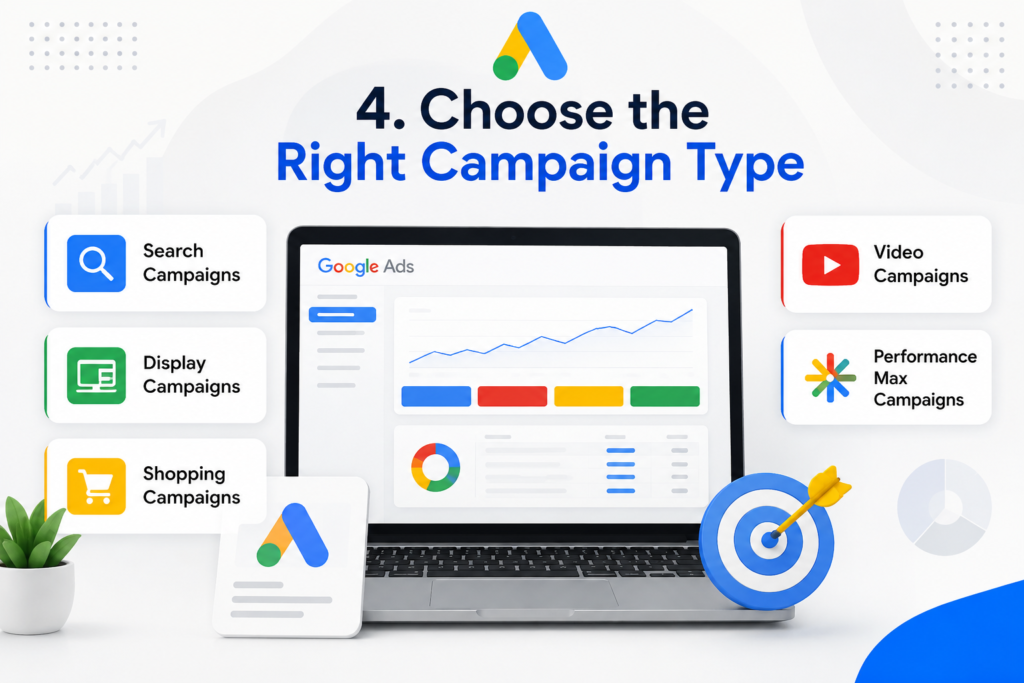
4. Choose the Right Campaign Type
Google Ads offers different campaign types designed for different business goals.
Search Campaigns
These text ads appear on Google search results when users search for specific keywords.
Best for:
- Lead generation
- Service businesses
- Local businesses
- High-intent customers
Display Campaigns
Image advertisements shown on websites, blogs, and mobile apps.
Best for:
- Brand awareness
- Remarketing
- Reaching large audiences
Shopping Campaigns
Ideal for e-commerce stores because they display product images, prices, and reviews directly in Google Search.
Video Campaigns
Ads shown on YouTube before or during videos.
Best for:
- Brand awareness
- Product launches
- Tutorials
- Customer education
Performance Max Campaigns
Uses Google’s artificial intelligence to display ads across all Google platforms automatically.
Best for businesses looking for maximum reach and automated optimization.
5. Perform Thorough Keyword Research
Keywords determine when your advertisements appear.
Choosing the wrong keywords wastes money.
Good keyword research involves understanding exactly what your customers are searching for.
For example, instead of using broad keywords like:
- Marketing
- Website
- SEO
Use more specific keywords such as:
- Best SEO agency near me
- Affordable Google Ads expert
- Website design company
- Local digital marketing services
- Professional social media management
Long-tail keywords often have lower competition and higher conversion rates because they target users with clear buying intent.
Use tools like:
- Google Keyword Planner
- Google Trends
- Google Search Suggestions
6. Understand Keyword Match Types
Google provides different keyword match options that determine how closely a search must match your keywords.
Broad Match
Your ad may appear for related searches.
Highest reach but lowest accuracy.
Phrase Match
Your ad appears when the search contains your keyword phrase.
Provides better targeting.
Exact Match
Your ad only appears for searches very similar to your keyword.
Highest relevance and usually better conversions.
Beginners should generally start with phrase match and exact match to maintain better control over their budget.
7. Write High-Converting Ad Copy
Your advertisement has only a few seconds to convince someone to click.
A great ad should include:
- Main keyword
- Customer benefit
- Unique selling point
- Strong call-to-action
Example:
Headline:
“Professional Google Ads Services”
Description:
“Increase leads and sales with expert Google Ads management. Get a free consultation today.”
Avoid generic advertisements that fail to explain why users should choose your business.
8. Create Attractive Headlines
Headlines are the first thing users notice.
Examples:
- Grow Your Business with Google Ads
- Affordable SEO Services
- Professional Website Design
- Increase Sales Online
- Book Your Free Consultation Today
- Trusted Digital Marketing Agency
Use numbers, action words, and benefits whenever possible.
9. Use Ad Extensions
Ad extensions provide additional information that makes your advertisement more useful.
Popular extensions include:
- Call Extension
- Location Extension
- Sitelink Extension
- Promotion Extension
- Callout Extension
- Structured Snippet Extension
- Price Extension
- Lead Form Extension
Benefits include:
- More visibility
- Higher click-through rate
- Better user experience
- Improved Quality Score
10. Build a Dedicated Landing Page
Never send users to your homepage if your ad promotes a specific product or service.
Instead, create a landing page specifically designed for that campaign.
A good landing page includes:
- Clear headline
- Relevant content
- Fast loading speed
- Mobile-friendly design
- Customer reviews
- Call-to-action button
- Contact form
- Phone number
- WhatsApp button
Your landing page should match the message shown in your advertisement.
11. Improve Your Quality Score
Quality Score is Google’s rating of your advertisement’s relevance.
A higher Quality Score usually means:
- Lower cost per click
- Better ad positions
- Higher click-through rates
- Improved return on investment
Improve Quality Score by:
- Using relevant keywords
- Writing keyword-rich ads
- Creating useful landing pages
- Improving website speed
- Increasing user engagement
12. Start with a Small Budget
Many beginners think spending more money guarantees better results.
Instead:
- Start with a modest daily budget.
- Test different ads and keywords.
- Analyze performance.
- Increase spending only after identifying profitable campaigns.
Testing first helps reduce risk and improves long-term performance.
13. Use Negative Keywords
Negative keywords prevent your ads from appearing for irrelevant searches.
Examples:
If you sell premium website design services, you may exclude:
- Free
- Jobs
- Internship
- Course
- Tutorial
- Template
Negative keywords improve targeting and reduce wasted advertising spend.
14. Target the Right Location
Location targeting ensures your advertisements reach customers in the areas you actually serve.
For example:
A beauty salon should advertise within its city.
A restaurant should focus on nearby neighborhoods.
An online business can target an entire country or multiple countries.
Proper location targeting improves conversion rates while reducing unnecessary spending.
15. Optimize for Mobile Users
Most Google searches now happen on smartphones.
Your website should:
- Load in under three seconds
- Display correctly on all screen sizes
- Have clickable phone numbers
- Include large buttons
- Use simple navigation
- Offer easy-to-complete forms
A poor mobile experience often leads to high bounce rates and fewer conversions.
16. Track Conversions
Clicks alone do not measure success.
Track meaningful actions such as:
- Purchases
- Contact forms
- Phone calls
- Appointment bookings
- Newsletter subscriptions
- WhatsApp inquiries
Conversion tracking helps identify which campaigns actually generate business.
17. Test Multiple Advertisements
Never rely on a single advertisement.
Create different versions using different:
- Headlines
- Descriptions
- Calls-to-action
- Display URLs
Testing helps you discover which combination delivers the best results.
18. Monitor Important Metrics
Google Ads provides detailed performance reports.
Important metrics include:
- Impressions
- Clicks
- Click-Through Rate (CTR)
- Cost Per Click (CPC)
- Conversion Rate
- Cost Per Conversion
- Quality Score
- Return on Ad Spend (ROAS)
Review these metrics regularly to improve your campaigns.
19. Use Remarketing Campaigns
Many users visit your website without taking action.
Remarketing allows you to show advertisements to previous visitors as they browse other websites or use YouTube.
Benefits include:
- Higher conversions
- Better brand recall
- Increased trust
- Lower acquisition costs
Remarketing often delivers some of the highest returns because it targets people who have already shown interest in your business.
20. Analyze Your Competitors
Studying successful competitors can provide valuable insights.
Look at:
- Keywords they target
- Ad headlines
- Offers
- Landing pages
- Promotions
- Calls-to-action
This helps you identify opportunities to improve your own campaigns.
21. Focus on User Experience
Google rewards advertisers who provide a positive user experience.
Improve your website by:
- Using fast hosting
- Reducing page load time
- Making navigation simple
- Using clear fonts
- Adding trust badges
- Displaying customer testimonials
- Providing secure checkout (HTTPS)
A better user experience leads to higher conversions and better Quality Scores.
22. Keep Learning
Google Ads evolves continuously with new features, bidding strategies, and AI-powered tools.
Stay updated by:
- Reading Google’s official documentation.
- Watching educational videos.
- Taking online certification courses.
- Following digital marketing blogs.
- Testing new campaign types.
- Reviewing your campaign reports regularly.
The more you learn, the better your campaigns will perform.
Common Mistakes Beginners Should Avoid
- Launching campaigns without clear goals
- Targeting overly broad keywords
- Ignoring negative keywords
- Sending traffic to an unrelated homepage
- Writing weak or generic ad copy
- Failing to track conversions
- Spending too much too quickly
- Ignoring mobile users
- Never testing different ad variations
- Not reviewing campaign performance regularly
Avoiding these mistakes can save money and significantly improve your results.
Final Thoughts
Google Ads is one of the fastest and most effective ways to reach customers who are actively searching for your products or services. While it may seem complex at first, beginners can achieve excellent results by focusing on the fundamentals: setting clear goals, researching the right keywords, writing compelling ad copy, targeting the right audience, and continuously optimizing campaigns based on performance data. Success does not come from spending the most money—it comes from delivering the right message to the right people at the right time.
With patience, testing, and continuous learning, Google Ads can become a powerful engine for business growth, helping you increase website traffic, generate qualified leads, improve sales, and build long-term brand visibility in an increasingly competitive digital marketplace.